
 EN
EN
 DK
DK
How to Use Public Transport in Copenhagen: A Complete Guide for Tourists
Copenhagen is one of the most expensive cities in Europe. But the good news is that you can save a lot of money if you know how to use public transport in Copenhagen. Compared with taxis, public transport is more affordable, easy to navigate, and comfortable. If you understand the system before your trip, getting around the city becomes much easier and much cheaper. Copenhagen’s public transport network includes metro, trains, buses, and harbour buses, and they all work together under one system. [1][2]
Why public transport matters in Copenhagen
One of the smartest ways to save money in Copenhagen is to use public transport instead of taxis. The city is well connected, and many visitors can travel between the airport, city center, hotels, and major attractions without needing a car at all. A journey from Copenhagen Airport to the city center usually takes around 15 to 20 minutes by train or metro, which makes public transport both practical and time-saving. [2]
Another advantage is that many hotels are in or near central areas such as Nørreport, Kongens Nytorv, and København H, all of which are well connected by metro, bus, and train. That means public transport is often the easiest way to get from the airport to your hotel and then continue exploring the city.
Types of public transport in Copenhagen
First of all, it is important to understand the main types of public transport available in Copenhagen.
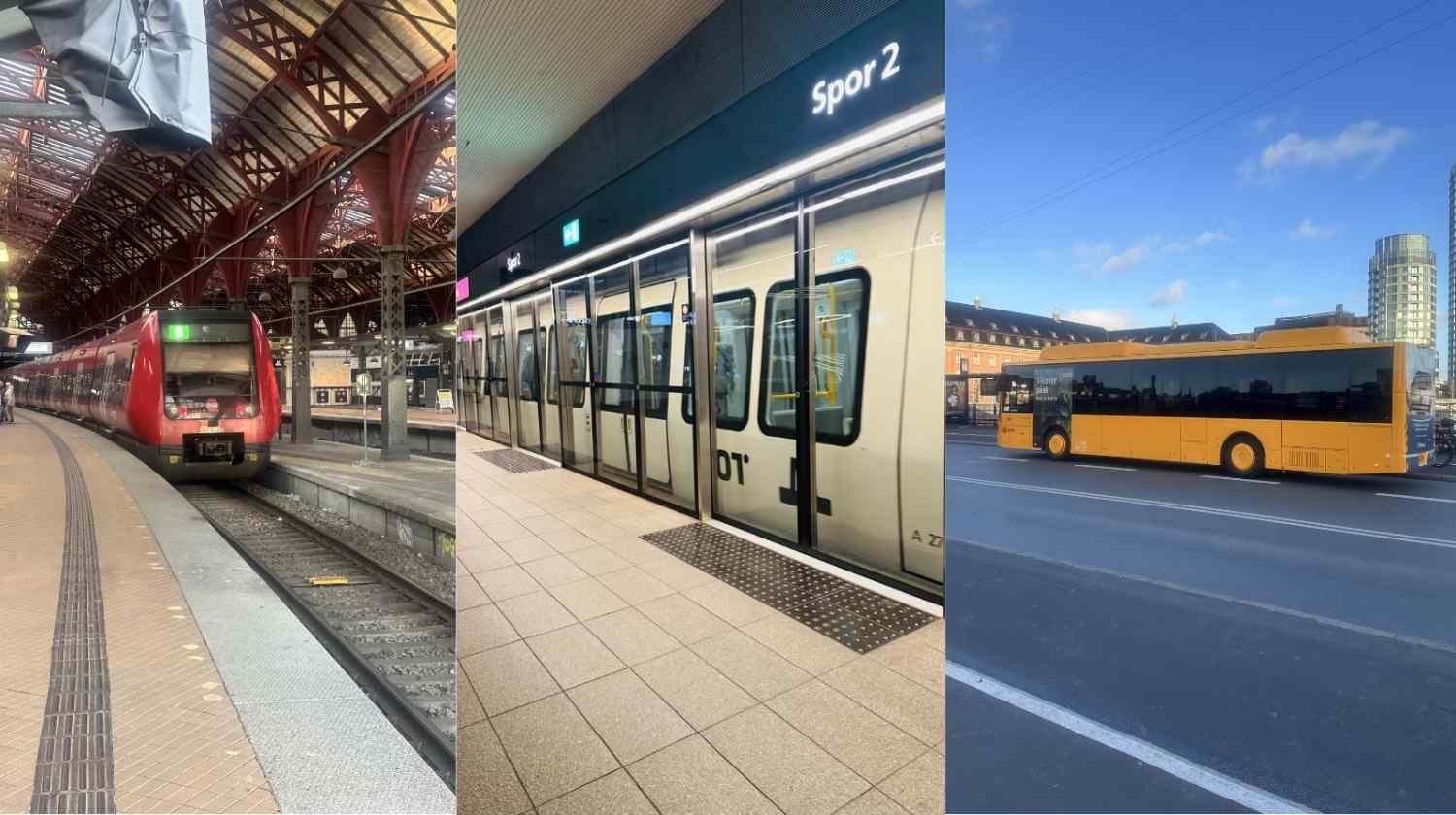
Metro:- The metro is one of the easiest and fastest ways to get around the city. It is modern, simple to use, and runs 24 hours a day, which is especially helpful if you arrive late at night or have an early flight. [2]
Train:- Trains are especially useful for traveling between Copenhagen Airport and central Copenhagen. If you are going to places such as København H or Nørreport, the train is often one of the quickest options. [2]
Bus:- The bus network is extensive and connects many areas that are not directly served by the metro. In many cases, buses are the most useful option for the final part of your journey, especially if your hotel is not right next to a metro or train station. [1]
Harbour bus:- The harbour bus is part of the normal public transport system, but it also gives you scenic views of the city from the water. The yellow harbour buses run on a regular public transport ticket, and the main route numbers are 991 and 992. [3][4]
For most tourists, the metro and bus are the most commonly used options, but trains and harbour buses can also be very useful depending on your route.
Where can you buy tickets?
The easiest way to buy tickets in Copenhagen is by using the Rejsebillet app. Official transport guidance says this is the easiest option for public transport tickets. You can also buy tickets from ticket machines at train stations, metro stations, and Copenhagen Airport. [1]. If you arrive at the airport and do not want to use an app, you can buy train and metro tickets at the DSB ticket office in Terminal 3 or from the ticket machines there. [2]

So in simple terms, you have three easy options:
- Buy your ticket in the Rejsebillet app
- Buy your ticket from a ticket machine
- Buy your ticket at the DSB ticket office in Terminal 3 at Copenhagen Airport
It is a good idea to download the app before arriving in Denmark. That can save time and make the first part of your journey much easier.
How do you buy a ticket?
Buying a ticket is quite simple. You enter your starting point and destination in the app, and it will show you the available journey options. The app also helps identify the correct fare and the zones needed for the journey, so you do not need to calculate everything yourself. Official guidance for the Rejsebillet app says it informs you of the zones required for your trip. [1]
This is one of the main reasons public transport in Copenhagen is easier than many tourists expect. Instead of worrying too much about the zone system, you can simply enter the route and let the app guide you.
For example, if you travel from CPH Lufthavn to København H, the app will show you the best options, including direct train and metro connections. If you travel from the airport directly to a hotel, the app may show a combination of metro, bus, and a short walk. That is especially helpful for tourists who do not know whether their hotel is closest to a train station, metro stop, or bus line.
How long is the ticket valid?
This is one of the most important things to understand. In Copenhagen, a ticket is not just for one bus or one metro ride. A zone ticket can be used for an unlimited number of journeys by bus, train, and metro within the time period and zones it is valid for. DSB’s terms for app tickets confirm unlimited travel within the validity period, and DSB also states that an extension ticket covering one additional zone is valid for 1 hour and 15 minutes. [5][6]
For common city journeys, a 2-zone ticket is valid for 1 hour and 15 minutes, and a 3-zone ticket is valid for 1 hour and 30 minutes. This means you can change from train to metro or from metro to bus without buying another ticket, as long as your ticket is still valid and covers the required zones. [5][6]
That is very useful for tourists because many journeys involve at least one transfer.
Do you need to understand the zones?
Technically, yes. Copenhagen public transport works with zones, and the ticket price depends on how many zones you travel through. But in practice, you do not need to stress too much about zones if you use the app correctly. Once you enter the starting point and destination, the app usually works out the correct zones for you. [1]
So yes, the zone system exists, but for most visitors the app makes the process much easier.
Is City Pass a good option for tourists?
For many visitors, yes. A City Pass is often one of the best choices if you plan to use public transport several times during your stay. It gives unlimited travel by bus, train, metro, and harbour bus for a fixed period. [7][8]
The City Pass Small covers zones 1–4, which includes central Copenhagen and travel to and from the airport. It is valid for 24, 48, 72, 96, or 120 hours. The lowest adult price is 100 DKK for 24 hours. [7][8]
This can be a very practical option if you plan to move around the city a lot in one or two days. If you are only using public transport once or twice, then normal single tickets may be enough.
Can you use Google Maps instead?
Yes. If you are already used to Google Maps, you can use it to plan your route instead of relying only on a transport app for navigation. Google Maps is often very helpful for understanding the journey step by step, especially when your route includes train, metro, bus, and walking.
A practical way to do this is simple: buy the ticket in the official app or at a ticket machine, then use Google Maps to follow the route.
This is especially helpful for tourists who prefer visual directions. Just remember that Google Maps is mainly for navigation. You should still buy your ticket through an official channel before you travel.
A very important tip before arriving in Denmark
Before arriving in Denmark, save your hotel’s full address in your phone. This may sound simple, but it can prevent a lot of confusion.
Some hotels in Copenhagen have similar names or belong to the same chain but are in different locations. If you only remember the hotel name, you may end up checking the wrong route or even arriving at the wrong place. Saving the exact address makes it much easier to use both the ticket app and Google Maps correctly.
This is especially useful after a long flight, when you want the fastest and easiest route from the airport to your accommodation.
Common mistakes to avoid
To make your journey smoother, try to avoid these common mistakes:
Buying a new ticket for every transfer :- You usually do not need to do that. As long as your ticket is still valid and covers the right zones, you can transfer between bus, train, and metro. [5][6]
Forgetting to buy or activate your ticket before travel :- Always make sure you have a valid ticket before you start your journey.
Ignoring public transport from the airport:- Many tourists take a taxi immediately after landing, even though the train and metro from Terminal 3 are fast, simple, and much cheaper. [2]
Not saving the exact hotel address:- This can easily lead to confusion, especially if hotels have similar names.
Don’t forget about the harbour bus
Many tourists focus only on the metro and train, but the harbour bus can also be a great experience. It is part of the normal public transport system and runs on a regular public transport ticket. The route has 11 stops and connects waterfront places such as The Royal Library, Islands Brygge, and Refshaleøen. The two route numbers are 991 toward Teglholmen and 992 toward Orientkaj. [3][4]
So if you have time, the harbour bus can be one of the nicest and most relaxing ways to move around Copenhagen while also seeing the city from the water.
Final thoughts
Copenhagen may be an expensive city, but transport is one area where you can save money if you know how the system works. Public transport is reliable, efficient, and much more budget-friendly than depending on taxis. Once you understand the different transport types, where to buy tickets, and how ticket validity works, getting around the city becomes very easy. [1][2]
My advice is simple: download the Rejsebillet app before arrival, save your hotel address, and check your route in advance. If you do that, getting from the airport to the city center or directly to your hotel becomes much easier. And if you already like using Google Maps, you can use that for directions after buying your ticket.
That way, even in one of Europe’s most expensive cities, you can still travel smart and save money.
Sources
[1] Public Transport Denmark, “Fares & Tickets” and “Getting Around.”
[2] Copenhagen Airport, transport information via Terminal 3 and journey times to the city center.
[3] Visit Copenhagen, “The Harbour Bus | See Copenhagen from the water.”
[4] Visit Copenhagen, harbour bus routes 991 and 992 and waterfront stops.
[5] DSB, ticket validity and unlimited travel within valid time/zones.
[6] DSB, extension ticket validity of 1 hour and 15 minutes for one extra zone.
[7] Public Transport Denmark, City Pass pricing and validity.
[8] Visit Copenhagen, City Pass Small covering zones 1–4 including the airport.
Tags :
TravelsShare On :


About Author
Posted by Copenhagen Memories
